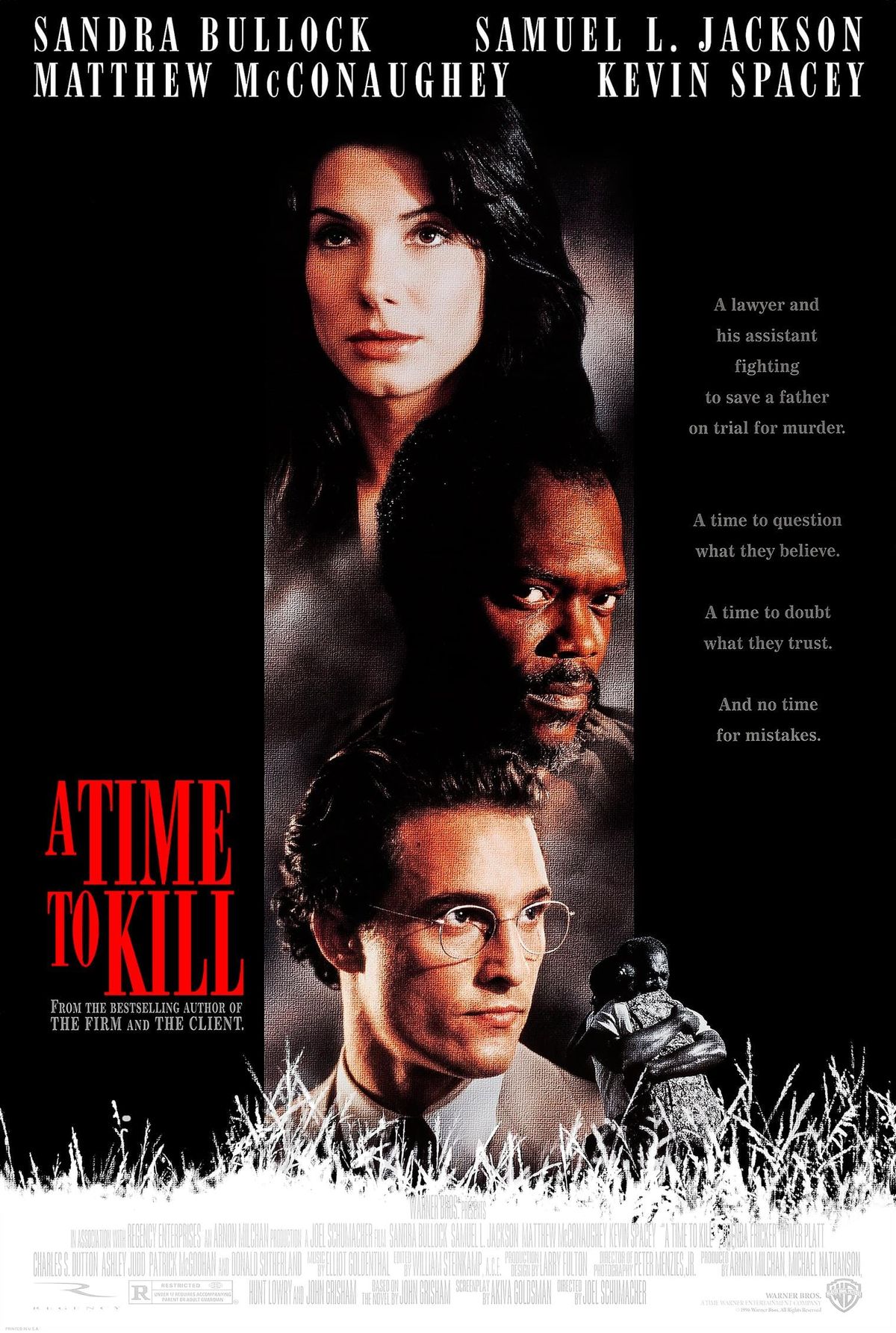
A Time to Kill (1996)

Score: 6 / 10
Category: Movie
Platform: Netflix
One-line verdict
Powerful premise and stacked cast, but the adaptation leaves too many gaps in logic and context.
Why I watched this
I’m a fan of courtroom movies and series. The appeal for me is always the investigation and how the truth slowly unfolds during the trial.
That’s what drew me to this.
The Netflix preview also showed a cast lineup that caught my attention: Matthew McConaughey, Samuel L. Jackson, Sandra Bullock, Kevin Spacey, Donald Sutherland, and Kiefer Sutherland.
Looking at it now in 2026, this feels like a star-packed movie. But back in the mid-90s, many of them were just starting to gain prominence.
After finishing the movie, I also found out it was based on John Grisham’s first novel.
Story & Structure
The story follows a lawyer defending a father who killed the two men responsible for assaulting his daughter. The trial becomes highly charged because the case also involves racial tensions and the presence of the Ku Klux Klan.
For a film made in the 90s, the themes are heavy — justice, racism, morality, and whether revenge can ever be justified.
That central question is strong. The movie challenges viewers to ask themselves how far justice should go when emotions are involved.
But the execution feels uneven.
There are moments where the film assumes viewers already understand what’s happening instead of explaining it clearly.
For example, when Carl Lee shoots the attackers, Jake later appears with blood on his shirt even though he wasn’t directly involved in the shooting. It’s a small detail, but it breaks immersion because the movie never explains it.
What worked
- The central moral dilemma is compelling.
- The cast delivers strong performances across the board.
- Samuel L. Jackson’s role gives the emotional weight needed for the trial.
The courtroom moments themselves are engaging when they focus on the ethical question rather than the procedural details.
What didn’t
Several characters feel unnecessary in the film adaptation.
Characters like Harry Rex and Lucien appear but don’t significantly affect the outcome of the story. It makes me suspect they had more meaningful roles in the novel that were lost during adaptation.
The movie also doesn’t explain some parts of the American court process, such as jury selection. For international viewers, this can be confusing.
Another distraction is the subplot involving Ellen Roark. It feels like a narrative detour rather than something essential to the main conflict. The tension between Jake and his wife also feels underdeveloped, especially the idea that he might be having an affair.
And oddly enough, one thing that stood out visually was how sweaty everyone looked throughout the movie. It’s hard to tell whether that was intentional for realism or simply the conditions during filming.
What others think
A Time to Kill is generally well regarded, especially for its performances and emotional courtroom scenes. Many viewers consider it one of the stronger legal dramas of the 90s.
Criticism tends to focus on pacing and the challenge of adapting a dense novel into a two-hour film — something I also felt while watching.
Final thoughts
The story itself is powerful. The question it raises about justice and revenge is what keeps the movie interesting.
But the adaptation feels compressed, leaving several moments underexplained.
Because of that, this lands at 6 / 10 for me.
Good premise.
Strong cast.
But uneven execution.